Confidence Intervals

UCLA Soc 114

Concepts for today

Statistical concepts

  • Sampling distribution
  • Standard error
  • Confidence interval
  • Bootstrap

Coding concepts

  • Writing a custom function
  • Writing a for loop

Example: Mean salary of MLB players

Load data:

baseball <- read_csv("https://soc114.github.io/data/baseball.csv") |>
  # Keep only a few variables for simplicity
  select(player, team, salary)
# A tibble: 944 × 3
  player             team      salary
  <chr>              <chr>      <dbl>
1 Bumgarner, Madison Arizona 21882892
2 Marte, Ketel       Arizona 11600000
3 Ahmed, Nick        Arizona 10375000
# ℹ 941 more rows

Example: Mean salary of MLB players

True mean in population of all players

baseball |> summarize(population_mean = mean(salary))
# A tibble: 1 × 1
  population_mean
            <dbl>
1        4965481.

Estimate from a sample

Draw a sample of 10 players.

sampled_players <- baseball |> 
  slice_sample(n = 10) |>
  print(n = 3)
# A tibble: 10 × 3
  player          team          salary
  <chr>           <chr>          <dbl>
1 Matz, Steven    St. Louis   10500000
2 Barlow, Scott   Kansas City  5300000
3 Pomeranz, Drew* San Diego   10000000
# ℹ 7 more rows

Estimate from a sample

Take the mean among sampled players.

sampled_players <- sampled_players |> 
  summarize(sample_estimate = mean(salary)) |>
  print()
# A tibble: 1 × 1
  sample_estimate
            <dbl>
1         8947500

Many times

If you are following, these are in many_samples.csv.

many_samples <- read_csv("https://soc114.github.io/data/many_samples.csv")

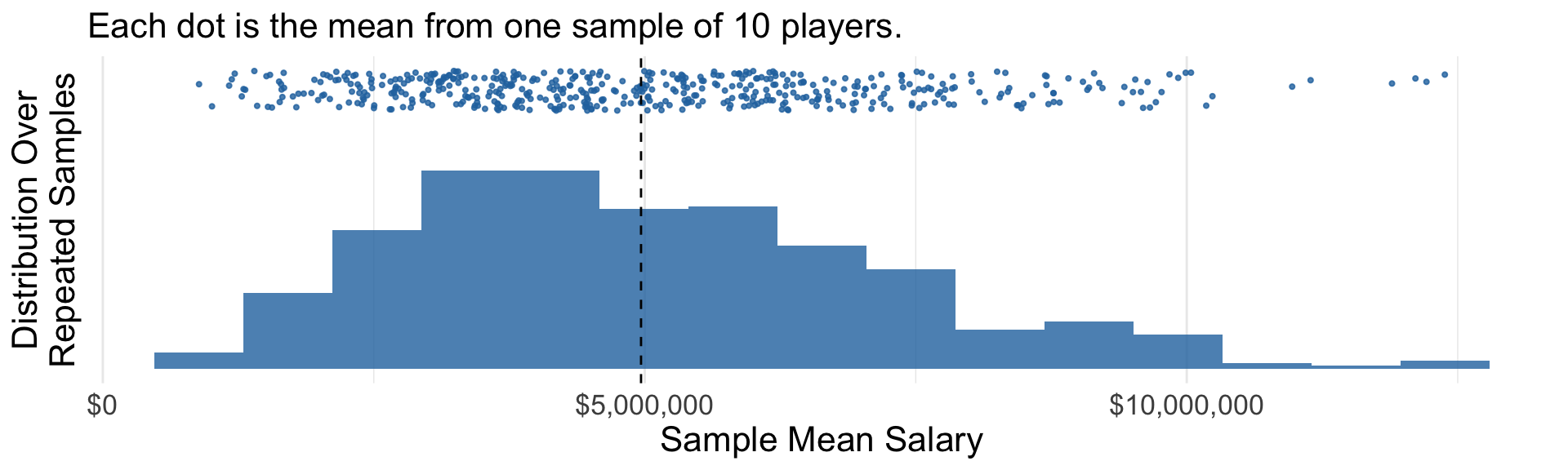
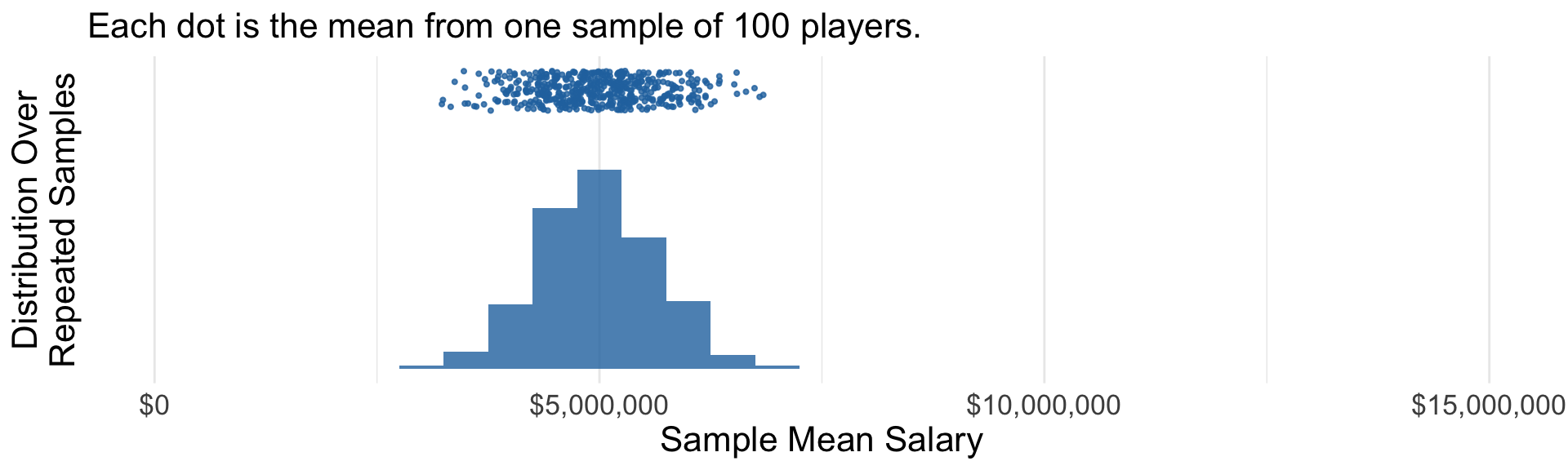
Because each sample produces a different estimate, there is a distribution of different estimates across repeated samples.

Can you propose a summary statistic for this distribution?

Mean of the distribution

Also called the expected value.

many_samples |>
  summarize(estimator_mean = mean(sample_estimate))
# A tibble: 1 × 1
  estimator_mean
           <dbl>
1       5036657.

(In practice, the mean of the distribution is unknown)

Standard Error

A measure of dispersion for the distribution of sample mean estimates.

many_samples |>
  summarize(standard_error = sd(sample_estimate))
# A tibble: 1 × 1
  standard_error
           <dbl>
1       2210213.

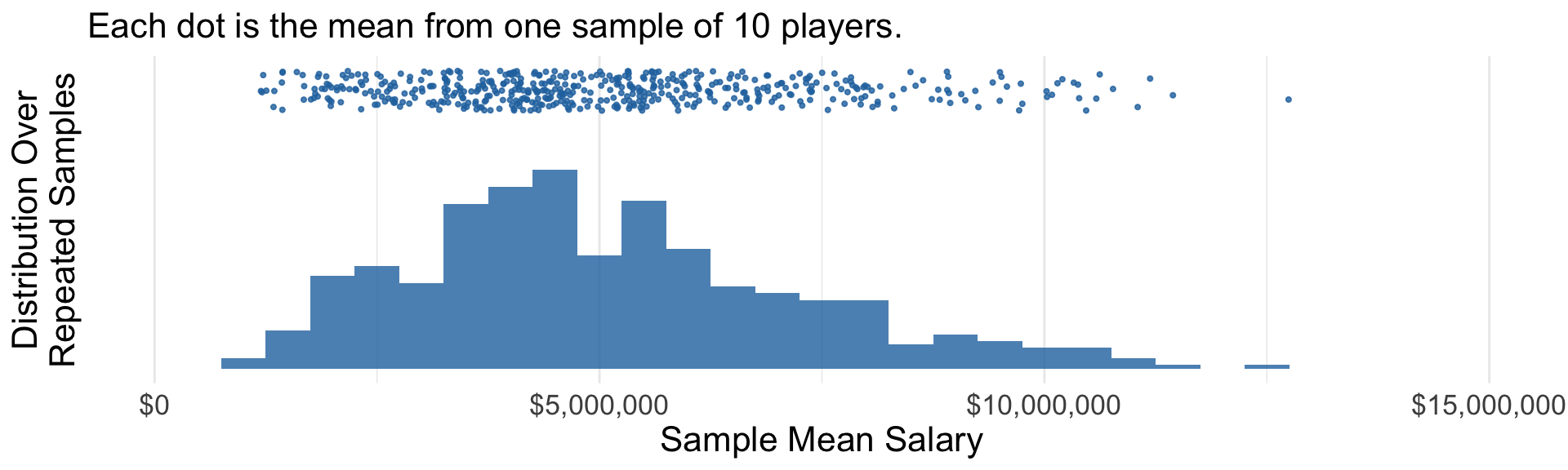
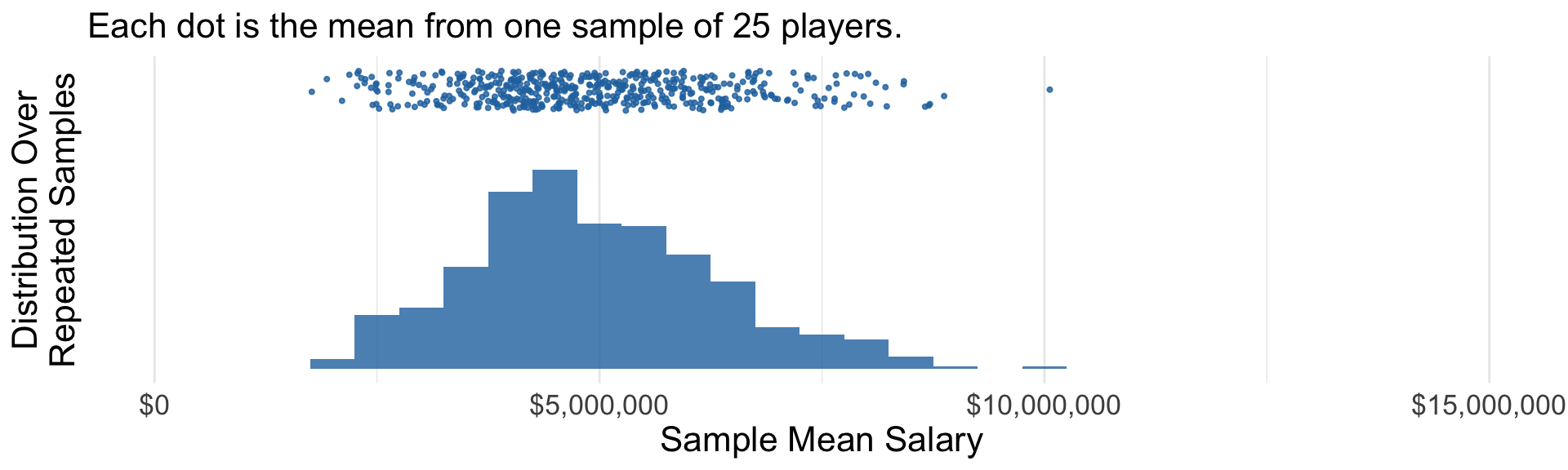
As the sample size grows

As the sample size grows

As the sample size grows

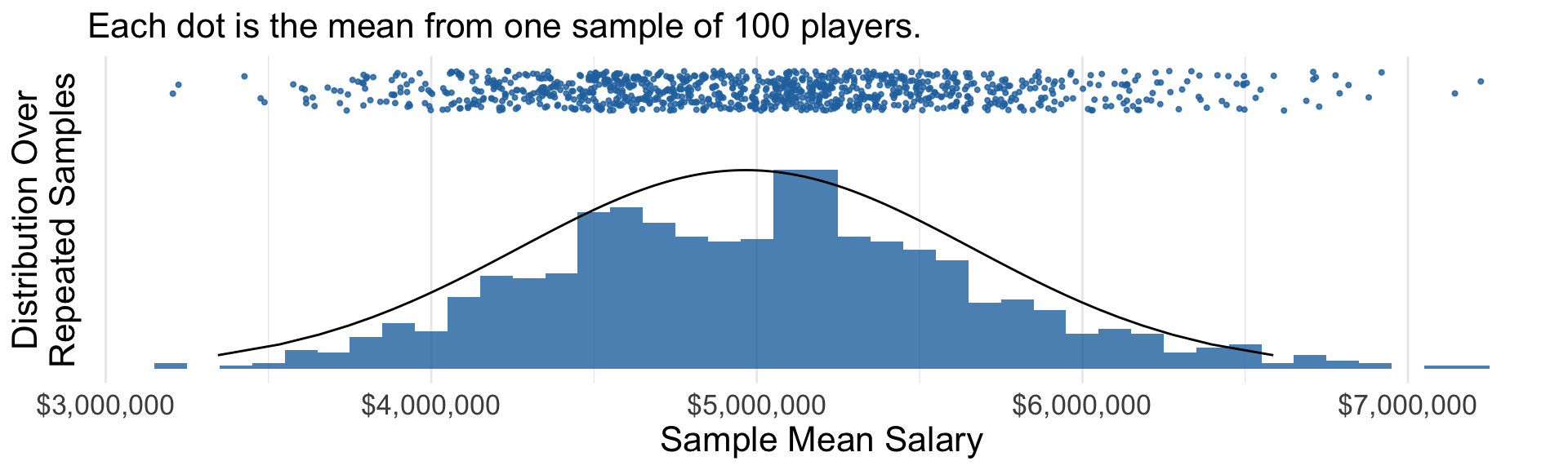
Asymptotic Normality

  • As the sample size gets large (asymptotic)
  • This becomes a Normal distribution

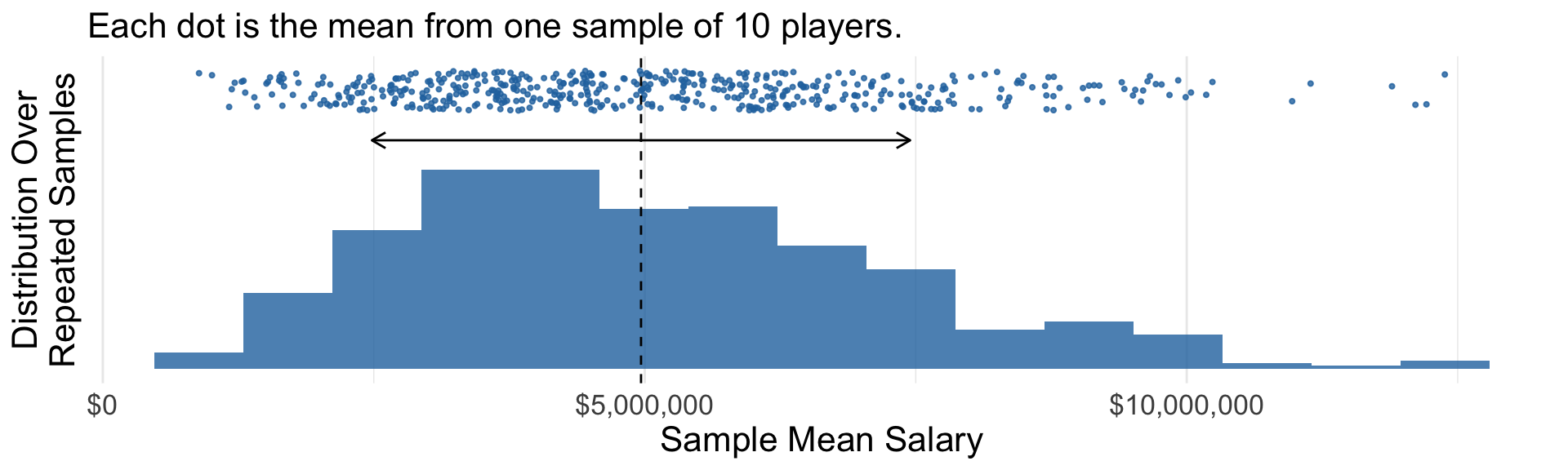
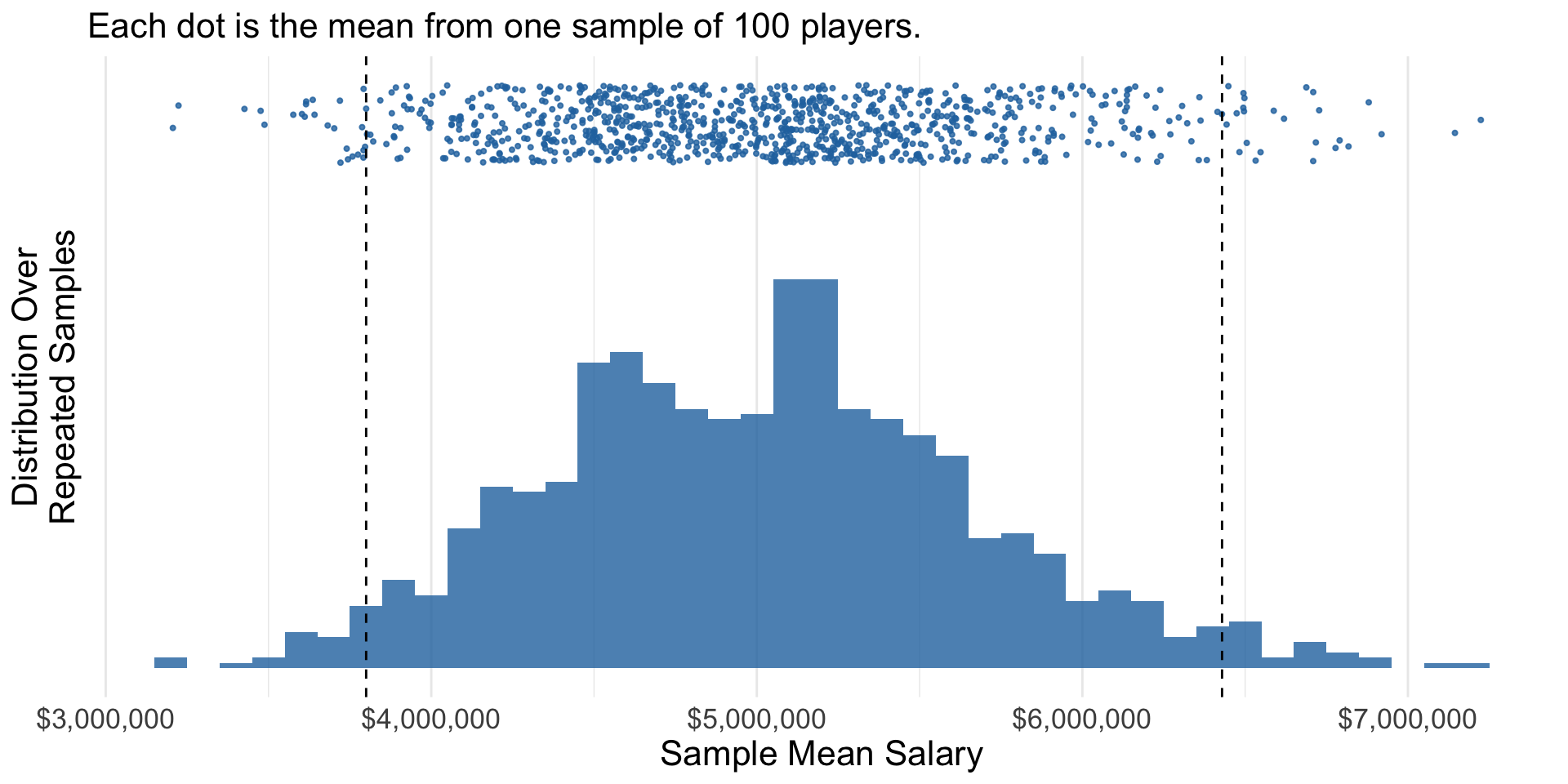
Middle 95% sampling interval

We might want to summarize:

  • The mean of the estimator
  • A range containing the middle 95% of sample estimates

Why is that hard to do with one actual sample?

Confidence interval via the bootstrap

What we want:

  1. We would want many samples: sample_1, sample_2, sample_3,…
  2. We estimate with each
  3. We summarize the middle 95%

Confidence interval via the bootstrap

What we can do:

  1. We get only one sample
    • So we simulate hypothetical sample_sim_1, sample_sim_2,…
  2. We estimate with each
  3. We summarize the middle 95%

How to generate bootstrap samples

Start with your one sample.

sampled_players <- baseball |>
  slice_sample(n = 100)

Resample \(n\) players with replacement.

sampled_players_bootstrap <- sampled_players |>
  slice_sample(prop = 1, replace = TRUE)

How to generate bootstrap samples: Example

Here is a sample of 3 players:

a_small_sample <- baseball |> 
  slice_sample(n = 3) |>
  print()
# A tibble: 3 × 3
  player              team       salary
  <chr>               <chr>       <dbl>
1 Houck, Tanner       Boston     740000
2 Gallegos, Giovanny  St. Louis 4750000
3 Hernandez, Jonathan Texas      995000

How to generate bootstrap samples: Example

Here is a bootstrap sample of those 3 players.

a_small_sample |> 
  slice_sample(prop = 1, replace = TRUE) |>
  print()
# A tibble: 3 × 3
  player             team       salary
  <chr>              <chr>       <dbl>
1 Gallegos, Giovanny St. Louis 4750000
2 Gallegos, Giovanny St. Louis 4750000
3 Houck, Tanner      Boston     740000

How to generate bootstrap samples: Example

Here is a bootstrap sample of those 3 players.

a_small_sample |> 
  slice_sample(prop = 1, replace = TRUE) |>
  print()
# A tibble: 3 × 3
  player              team       salary
  <chr>               <chr>       <dbl>
1 Gallegos, Giovanny  St. Louis 4750000
2 Hernandez, Jonathan Texas      995000
3 Gallegos, Giovanny  St. Louis 4750000

How to generate bootstrap samples: Example

Here is a bootstrap sample of those 3 players.

a_small_sample |> 
  slice_sample(prop = 1, replace = TRUE) |>
  print()
# A tibble: 3 × 3
  player              team  salary
  <chr>               <chr>  <dbl>
1 Hernandez, Jonathan Texas 995000
2 Hernandez, Jonathan Texas 995000
3 Hernandez, Jonathan Texas 995000

How to generate bootstrap samples: Example

Here is a bootstrap sample of those 3 players.

a_small_sample |> 
  slice_sample(prop = 1, replace = TRUE) |>
  print()
# A tibble: 3 × 3
  player             team       salary
  <chr>              <chr>       <dbl>
1 Houck, Tanner      Boston     740000
2 Gallegos, Giovanny St. Louis 4750000
3 Gallegos, Giovanny St. Louis 4750000

Coding concepts

We will analyze hundreds of bootstrap samples.

We need two coding concepts.

  1. How to write an estimator function
  2. How to write a for loop

How to write an estimator function

A function (like mean) takes an input and returns an output. You can write your own.

estimator <- function(data) {
  data |>
    summarize(estimate = mean(salary)) |>
    pull(estimate)
}

The function takes data and returns an estimate.

estimator(data = sampled_players)
[1] 6254938

How to write a for loop

Useful for tasks you will repeat.

First, initialize a vector to hold results.

vector_for_results <- rep(NA, 3)

The rep function repeates the value NA 3 times.

Second, loop through and fill your vector.

for (index in 1:3) {
  vector_for_results[index] <- index
}

Square brackets [] extract an element of a vector.

Analyze 500 bootstrap samples

Initialize a vector to hold the result.

bootstrap_estimates <- rep(NA, times = 500)

Analyze 500 bootstrap samples

Write a for loop that will repeat 500 times.

for (index in 1:500) {
  
  # Draw a bootstrap sample
  bootstrap_sample <- sampled_players |>
    slice_sample(prop = 1, replace = TRUE)
  
  # Construct an estimate
  estimate_this_index <- estimator(bootstrap_sample)
  
  # Store that estimate
  bootstrap_estimates[index] <- estimate_this_index
}

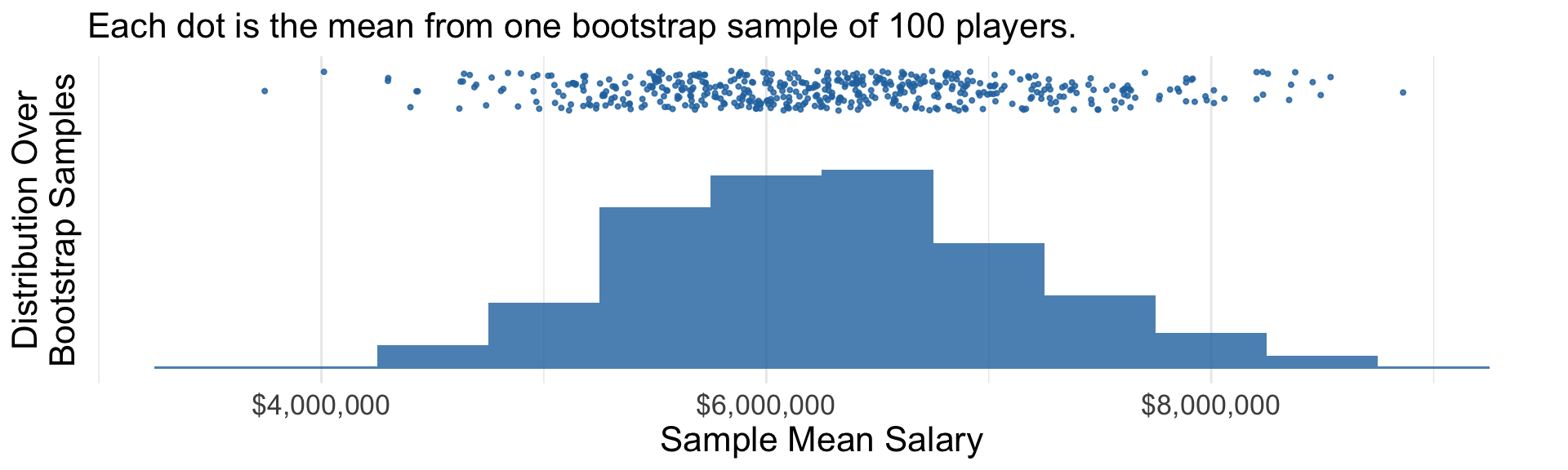
Bootstrap results

Bootstrap results: Summary statistics

Bootstrap estimate of the standard error.

sd(bootstrap_estimates)
[1] 853093.5

Middle 95% of bootstrap estimates

quantile(x = bootstrap_estimates, prob = c(.025, .975))
   2.5%   97.5% 
4691641 8036999 

Confidence interval

An interval from \(\text{lower}(\text{sample})\) to \(\text{upper}(\text{sample})\) with the property: across repeated samples, 95% of intervals constructed this way would contain the population parameter.

Confidence interval: Example

Middle 95% of bootstrap estimates is a confidence interval.
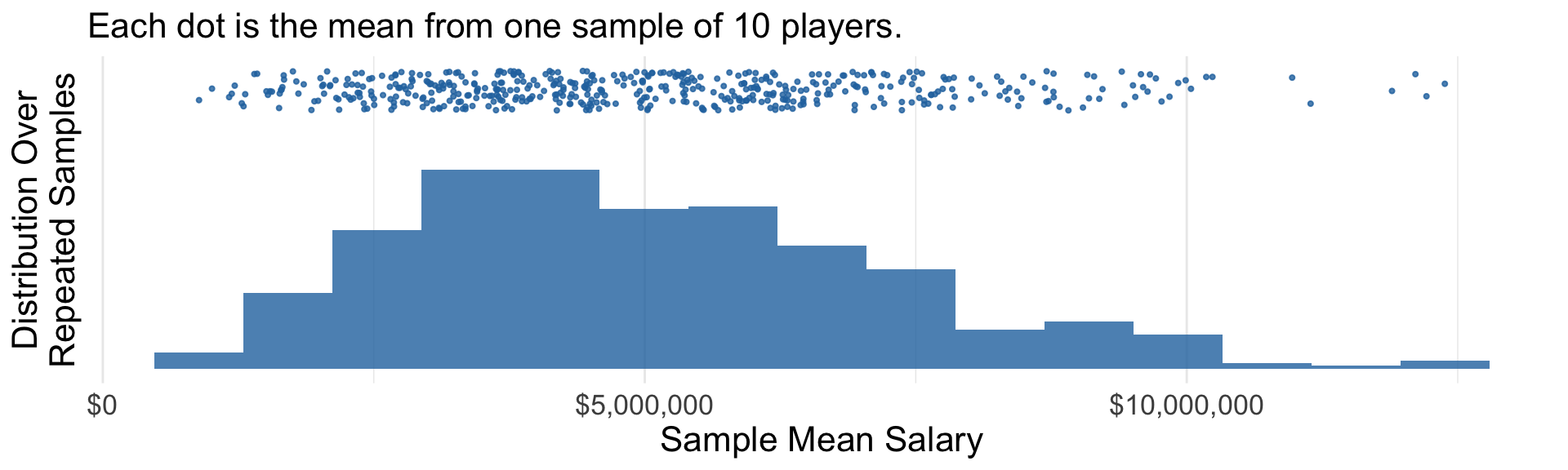
  • The true population mean salary is $4,965,481
  • Our sample mean is $6,254,938
  • Our confidence interval is:
quantile(x = bootstrap_estimates, prob = c(.025, .975))
   2.5%   97.5% 
4691641 8036999 

Across repeated samples, 95% of intervals constructed this way will contain the population mean salary.

Recap

  • Statistical concepts
  • Coding concepts

Recap: Statistical concepts

Statistical concepts

  • Sampling distribution
    • Cannot be directly observed. We have one sample.
  • Standard error
    • Spread of the sampling distribution
  • Confidence interval
    • Covers truth in 95% of samples
  • Bootstrap
    • Method of constructing the CI with one sample

Recap: Coding concepts